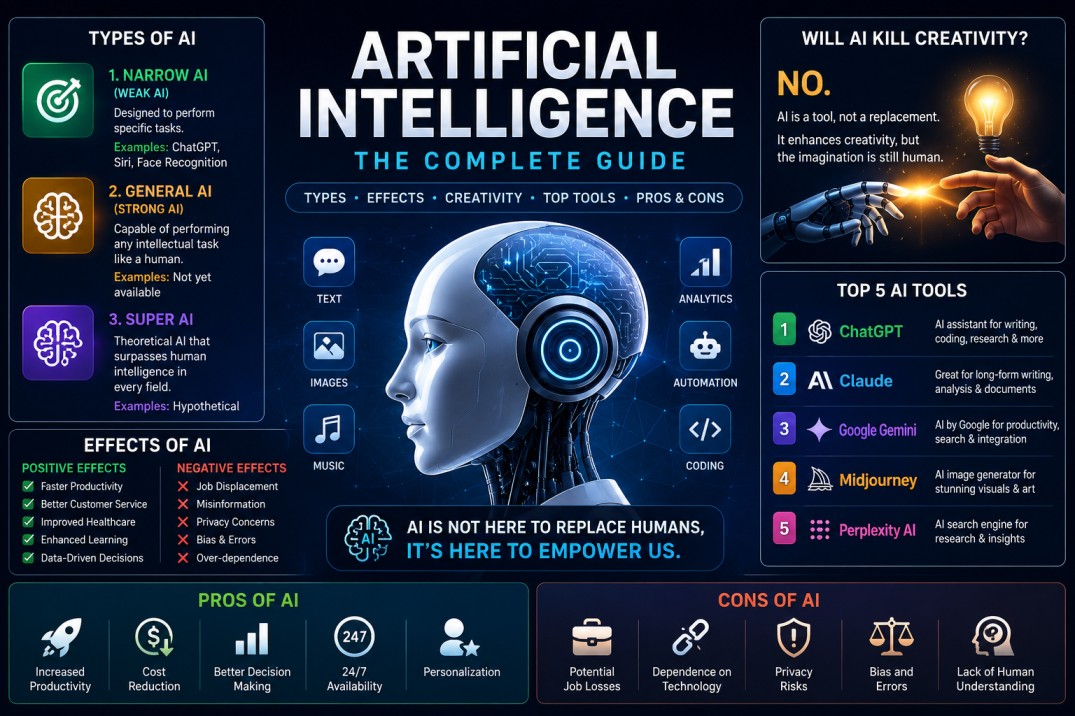
Artificial Intelligence (AI): Types, Effects, Top Tools, Pros & Cons, and the Future of Creativity
Artificial Intelligence (AI) is transforming the way we work, learn, create, and communicate. From writing content and generating images to analyzing data and automating business processes, AI has become one of the most influential technologies of the 21st century.
But what exactly is AI? What are its different types? Can AI replace human creativity? And which AI tools are leading the industry today?
Let’s explore everything you need to know.
What is Artificial Intelligence?
Artificial Intelligence refers to computer systems designed to perform tasks that normally require human intelligence. These tasks include learning, reasoning, problem-solving, language understanding, image recognition, and decision-making.
Examples of AI in daily life include:
- Google Search suggestions
- YouTube recommendations
- Voice assistants like Siri and Alexa
- Chatbots
- AI image generators
- Self-driving vehicles
Types of Artificial Intelligence
1. Narrow AI (Weak AI)
This is the most common form of AI today. It is designed to perform specific tasks.
Examples:
- ChatGPT
- Google Translate
- Netflix recommendations
- Face recognition systems
2. General AI (Strong AI)
General AI would be capable of performing any intellectual task that a human can do. This type of AI does not currently exist.
Examples:
- No real-world examples yet
- Often seen in science fiction movies
3. Super AI
A theoretical future AI that surpasses human intelligence in every field.
Examples:
- Currently hypothetical
- Featured in movies and futuristic discussions
Effects of AI on Society
AI is changing almost every industry.
Positive Effects
Faster Productivity
Tasks that once took hours can now be completed in minutes.
Example:
A marketer can generate ad copies, social media posts, and emails using AI tools.
Better Customer Service
AI chatbots provide instant responses 24/7.
Example:
Businesses use AI-powered WhatsApp chatbots to handle customer inquiries.
Improved Healthcare
AI helps doctors analyze medical scans and detect diseases earlier.
Enhanced Learning
Students can use AI tutors to understand difficult concepts quickly.
Negative Effects
Job Displacement
Some repetitive jobs may become automated.
Examples:
- Data entry
- Basic customer support
- Simple content generation
Misinformation
AI can generate fake news, fake images, and misleading content.
Privacy Concerns
AI systems often require large amounts of data, raising privacy and security issues.
Will AI Kill Creativity?
This is one of the most debated questions today.
The Short Answer: No
AI is unlikely to kill creativity. Instead, it changes how creativity works.
Why AI Won’t Replace Human Creativity
AI generates content based on existing data. Humans create based on emotions, experiences, imagination, and personal perspectives.
For example:
AI can generate:
- Blog posts
- Images
- Music
- Marketing ideas
Humans provide:
- Original vision
- Storytelling
- Emotions
- Cultural understanding
- Innovation
A Real Example
A designer using AI image generators can create concept art in seconds. However, deciding the final design direction still requires human creativity and judgment.
Think of AI as a powerful assistant rather than a replacement for creative professionals.
Top 5 AI Tools in 2026
1. ChatGPT
One of the most popular AI assistants for writing, coding, research, and business tasks.
Best for:
- Content creation
- Coding assistance
- Research
- Learning
2. Claude
A powerful AI assistant known for handling large documents and detailed analysis.
Best for:
- Long-form writing
- Documentation
- Research summaries
3. Google Gemini
Google’s AI platform integrated with many Google services.
Best for:
- Productivity
- Search assistance
- Workspace integration
4. Midjourney
An AI image generation tool known for producing artistic and highly detailed visuals.
Best for:
- Graphic design
- Concept art
- Marketing creatives
5. Perplexity AI
An AI-powered search and research assistant that provides sourced answers.
Best for:
- Research
- Fact-finding
- Learning new topics
Pros of Artificial Intelligence
Pros
AI automates repetitive tasks and saves time.
Businesses can reduce operational costs through automation.
AI analyzes large amounts of data quickly.
AI systems can work continuously without breaks.
AI provides customized experiences based on user preferences.
Cons
Potential Job Losses: Some routine jobs may become automated.
Dependence on Technology: Over-reliance on AI can reduce critical thinking skills.
Privacy Risks: Improper use of data can lead to privacy concerns.
Bias and Errors: AI systems can sometimes produce biased or inaccurate results.
Lack of Human Understanding: AI does not truly understand emotions or human experiences.
The Future of AI
AI will continue to evolve and become more integrated into our daily lives. Businesses, students, creators, and professionals who learn to work alongside AI will likely gain significant advantages.
The future belongs not to those who compete against AI, but to those who learn how to use AI effectively.
Final Thoughts
Artificial Intelligence is neither entirely good nor entirely bad. Like any powerful technology, its impact depends on how people use it.
AI can improve productivity, creativity, education, healthcare, and business operations. At the same time, it presents challenges related to jobs, privacy, and misinformation.
Rather than replacing human creativity, AI is becoming a powerful tool that helps people create faster, learn better, and innovate more efficiently.
The smartest approach is to embrace AI, understand its strengths and limitations, and use it responsibly to unlock new opportunities.